AI competitive advantage: context beats data
AI competitive advantage: everyone uses the same models. Context makes the difference, meaning the knowledge only your company has.
Read more →Insights from practice — on digitalisation, AI, leadership and governance for Swiss SMEs.
AI competitive advantage: everyone uses the same models. Context makes the difference, meaning the knowledge only your company has.
Read more →Innovation or security? How executive teams combine both with AI: lessons from digitalisation and security, and the layer model.
Read more →Department-owned knowledge was the success model of industrialisation. Working with AI, the same structure produces systematically worse results. What needs to change runs deeper than a process.
Read more →Many hope AI will sort out the mess. It does the opposite: it amplifies and cements it. Why now is the cheapest moment to bring order.
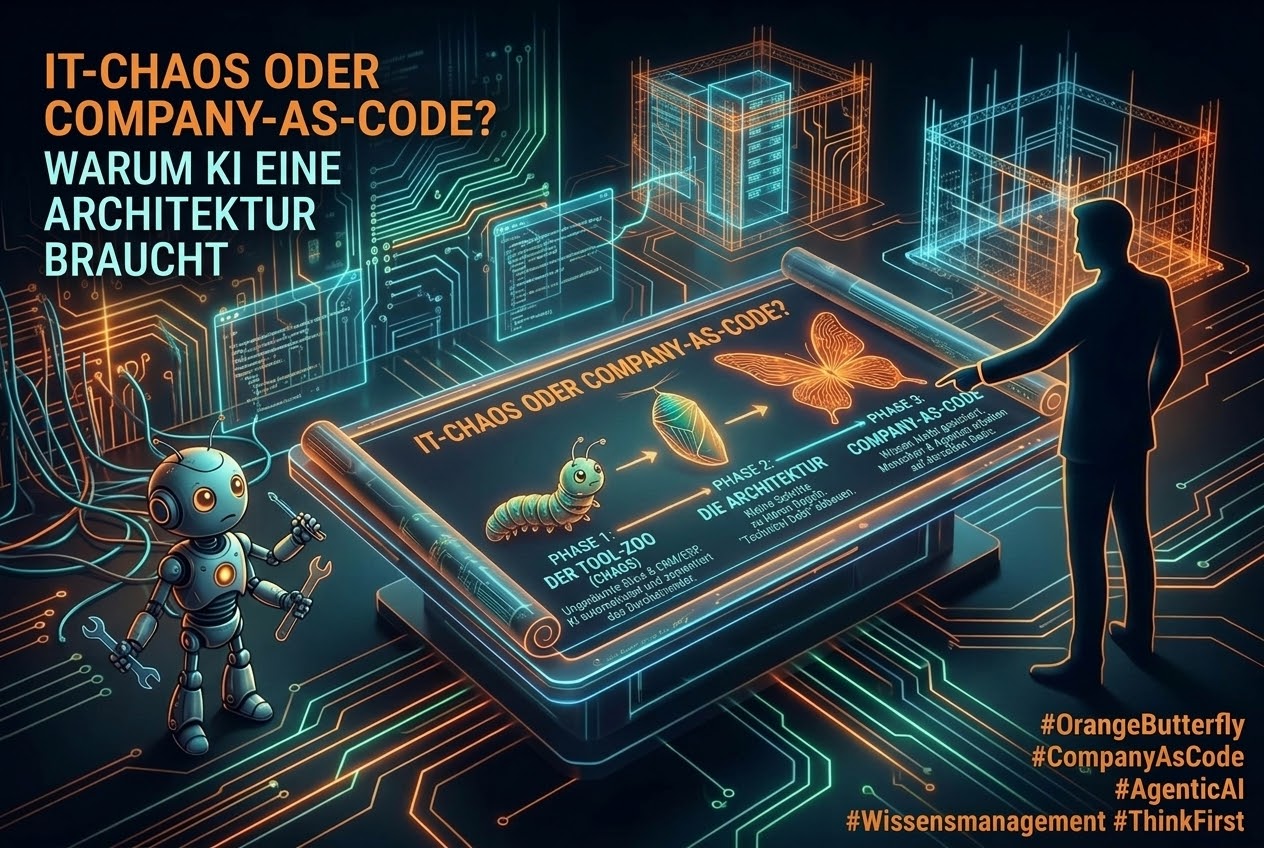
Read more →Behind every org chart lies a second code: undocumented, tightly coupled, hard to change. How it works, why AI agents make it urgent to surface it, and where to start.
Read more →AI reduces routine work. What remains is intensive thinking. Why teams with AI support are often more exhausted than before, and what leaders can do about it.
Read more →Which AI tool should we introduce? The more important question rarely gets asked: can the AI actually find what your company knows? Organise knowledge before adopting tools.
Read more →AI projects rarely fail because of the technology. They fail because of prerequisites nobody knew about and voices that were heard too late. Why deciding who sits at the table — and when — is a leadership decision.
Read more →Most AI agents fail not because of the model. They fail because nobody thought through the architecture before the first agent went live. What leaders already know how to do.
Read more →Governance does not slow down AI projects. But governance as an afterthought does. Why your rulebook should be the first step in architecture planning, not the last.
Read more →The real leadership question after the Business Excellence Forum is not "Which AI do we use?" but "Who wrote the rules?" Three questions every executive should be able to answer.
Read more →Deploying AI agents without an overarching architecture multiplies the problem instead of solving it. Why Think-First applies to agent deployment too — and what onboarding looks like in practice.
Read more →Everyone already knows what the solution is. But the problem has not been described yet. This pattern is more common than you think. And it costs more than any poorly implemented software.
Read more →Almost every mandate grows beyond the first question after three to four months. Governance gaps surface during an AI analysis. Cultural themes emerge mid-way through a security architecture project. The Reisepass turns the moment trust emerges into a reliable structure.
Read more →The cinema was dark. Ronja sat beside me. On the screen ran the film "Glennkill" — and soon only one question circled in my head: how much of this is actually real? Did an AI generate it?
Read more →When companies enter genuine uncharted territory: unknown markets, disruptive technologies, fundamental reorganisations. Classical project methods fail systematically there. Design Thinking does not. Why that is the case and how the method brings structure to chaos without sacrificing openness.
Read more →Governance has an image problem. Most people associate it with bureaucracy, slowness and control. The opposite is true when governance is set up correctly.
Read more →AI is changing more than processes: it is reshaping how decisions are made, who makes them, and what leadership even means. What this means concretely for management teams.
Read more →Digital transformation rarely fails because of technology. It fails because it is treated like a project, with a start signal, budget and end date. Why the metamorphosis metaphor is more than just a metaphor.
Read more →AI tools are productive. But while we celebrate the efficiency gain, a dangerous phenomenon creeps in: cognitive surrender. We are not just outsourcing tasks — we are outsourcing our thinking.
Read more →